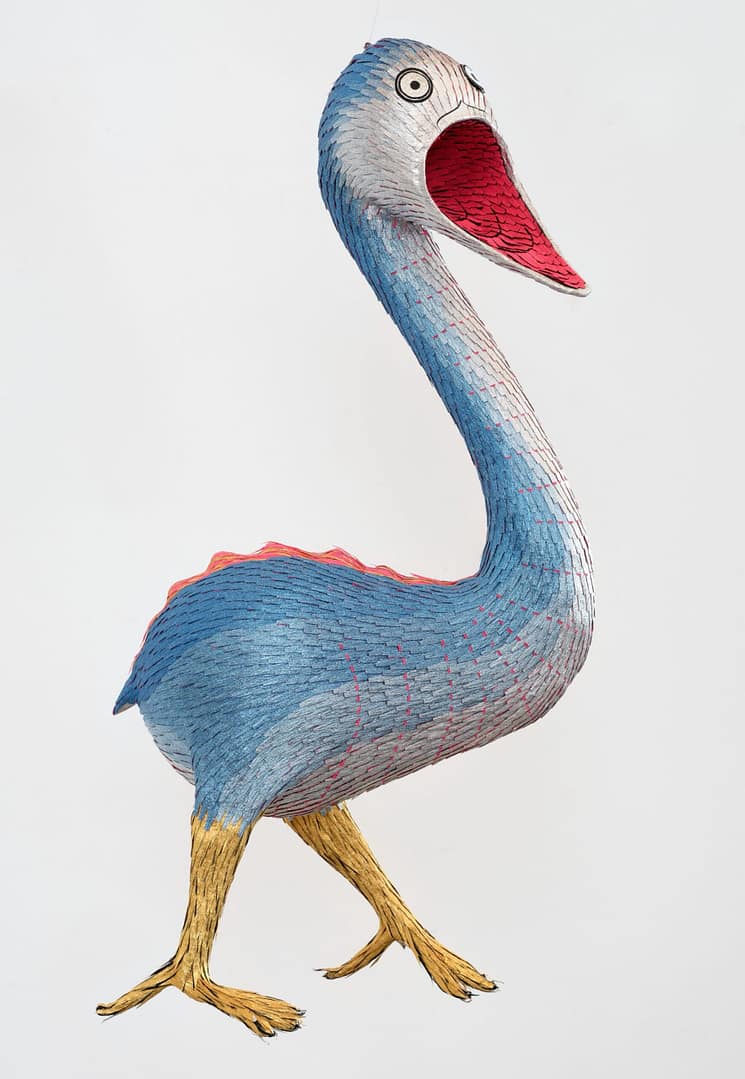
“Illuminated Piñata No. 19” (2021), paper, paperboard, glue, wire, and crepe paper, 33 x 20 x 12 inches. Photos by Paul Salveson. All images courtesy of the artist and Perrotin, shared with permission (2021), paper, paperboard, glue, wire, and crepe paper, 33 x 20 x 12 inches. Photos by Paul Salveson. All images courtesy of the artist and Perrotin, shared with permission
Most often associated with Mexico, the piñata’s origins may actually trace back to China. By the 14th century, the celebratory tradition of breaking open a container filled with treats had arrived in Europe. Then, Spanish colonists and missionaries imported the custom to Mexico during the 16th century, although a similar practice was already in use within Indigenous Mayan and Aztec communities in observation of special events. Today, piñatas are an integral element of cartonería, the Mexican craft of papier-mâché.
For Los Angeles-based artist Roberto Benavidez, the art of the piñata is a central tenet of a practice exploring intersecting themes of race, sexuality, humor, sin, and beauty. He draws upon the paper art form’s early religious significance in Mexico, when Spanish missionaries used a seven-pointed version as a tool for converting Indigenous people to Christianity. This motif, which appears in some of Benavidez’s distinctive sculptures, nods to its past colonial use.