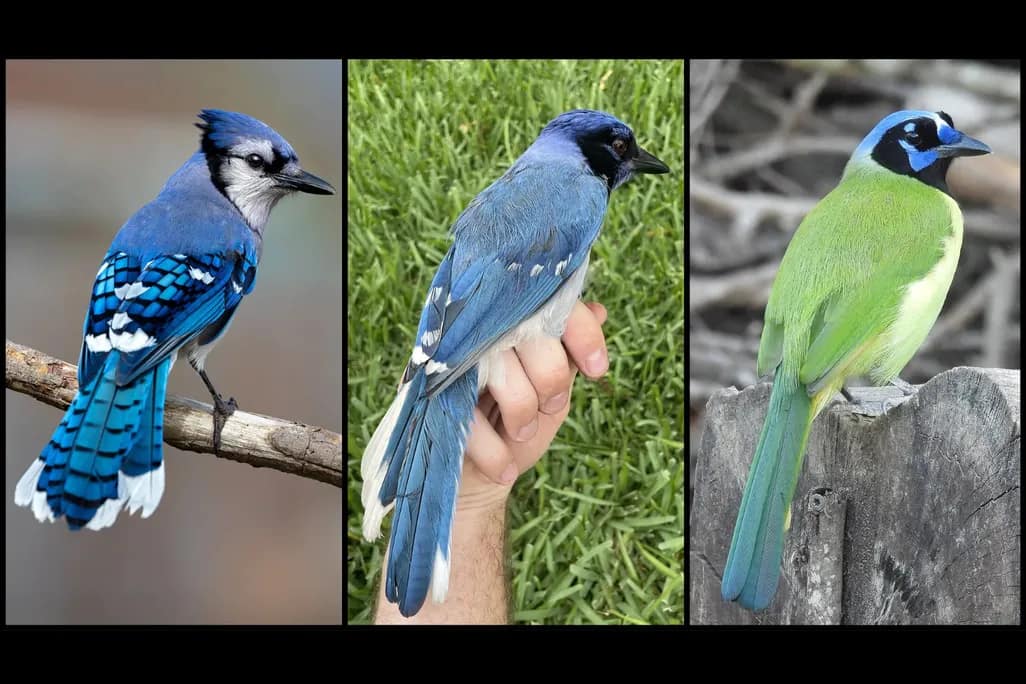
A male blue jay on the left, a female green jay on the right and a hybrid offspring of the two species in the center. Travis Maher / Cornell Lab of Ornithology / Macaulay Library (left); Brian Stokes (center); Dan O’Brien / Cornell Lab of Ornithology / Macaulay Library (right)
Two years ago, Brian Stokes, a PhD student studying green jays at the University of Texas at Austin, came across an image on social media featuring a strange animal sighted in a suburb northeast of San Antonio. The blue bird had a white chest and a black mask—it looked a bit like a blue jay, but still very different.
Curious, he reached out to the photographer, who invited Stokes to her backyard. Seeing the bird for himself, he realized they had found something unique and somewhat alarming: a natural hybrid between a blue jay and a green jay.
“We think it’s the first observed vertebrate that’s hybridized as a result of two species both expanding their ranges due, at least in part, to climate change,” Stokes explains in a university statement. The finding is particularly surprising because green jays and blue jays branched away from each other in the evolutionary tree seven million years ago. And as recently as a few decades ago, their habitats did not even overlap.