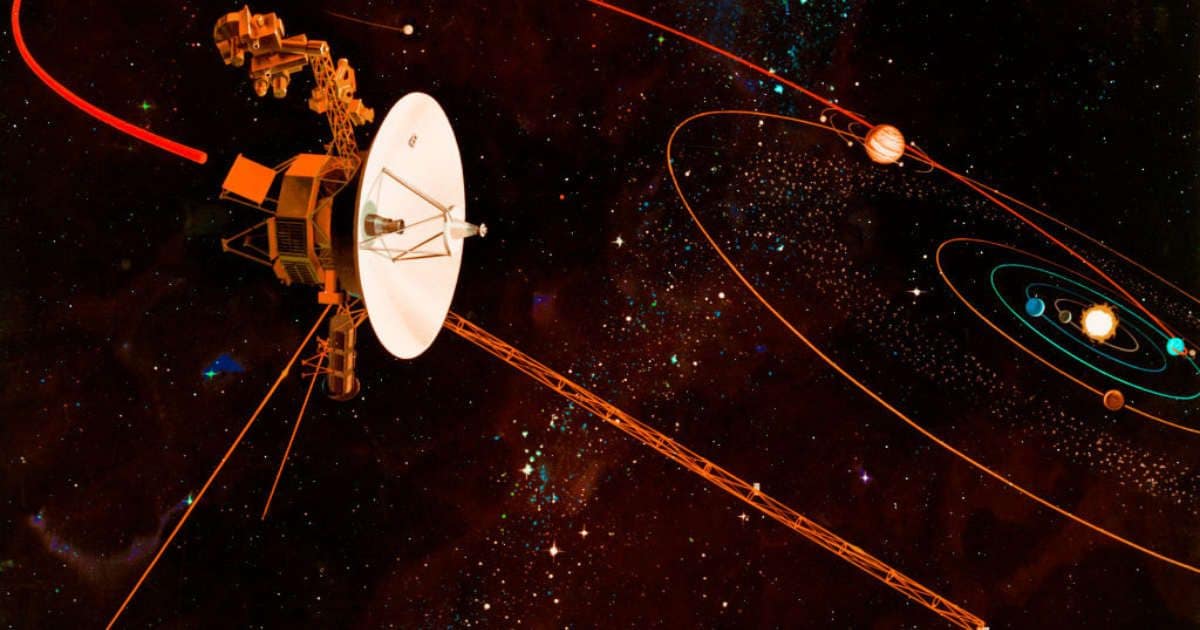
An artist's impression of the trajectory to be taken by NASA's Voyager 1 and Voyager 2 space probes. (Cover Image Source: Getty Images | Photo by Space Frontiers)
The probe entered a region beyond the heliopause, where temperatures are incredibly high, and continued to function despite all the hazards.
The journey of the 50-year-old NASA’s Voyager 1 was nothing short of surprising, as it remained functional years later and against all odds. A recent discovery found that the probe survived an estimated 50,000°C, according to a NASA dataset. The region was termed by scientists as a kind of interstellar “firewall,” according to the Daily Galaxy. This area was a turbulent, high-energy boundary at the farthest edge of our solar system. The space was situated a little beyond the heliopause, a boundary that separated the solar wind from the interstellar medium. The probe detected unusually high temperatures in an environment that was thought to be relatively stable.